How to plan an executive retreat that changes something
Most offsites produce a good week and a quiet nothing. The difference is decided long before anyone books a flight, in the question you choose to work on.
Every year, executive teams spend a remarkable amount of money and goodwill on retreats that leave everyone pleasantly tired and change nothing at all. The week is enjoyable, the photographs are good, and by the second Monday the calendar has closed over the top of it. This is rarely a failure of the venue or the food. It is a failure of design, and it usually happens in the first conversation, months before the retreat begins.
Start with the decision, not the destination
Most briefs we receive begin with a place: somewhere warm, somewhere quiet, not too far from an airport, somewhere the team can talk. That is entirely reasonable, and it is also backwards. Before the map there is a decision the team has been avoiding. A restructure everyone knows is needed. A founder whose presence has quietly stopped the room from disagreeing. A strategy that is clear in the slide deck and vague in the actual work. If the retreat does not exist to move that decision, the days will be spent in pleasant abstraction and the team will return to exactly the same stuck place.
So the first question is not where. It is: what will be different on the Monday after? Write the answer as a sentence you would be willing to read out loud to the whole team. If you cannot, you are not yet ready to book anything.
Choose one question, and let it be uncomfortable
Teams arrive with a list of goals: alignment, connection, energy, clarity, psychological safety. Each is a good thing. Together they cancel each other out, because no single hour of any programme can serve all of them. One precise question will do more work than five ambitions.
A framing question we often open with: “If we could be honest about one thing this week, what would it cost us to say it out loud?”
A useful question has three properties. It belongs to the whole group rather than to the leader alone. It cannot be answered by a presentation. And it carries consequences that show up in next quarter’s work, not only in how people felt on the last evening.
Let the place do part of the work
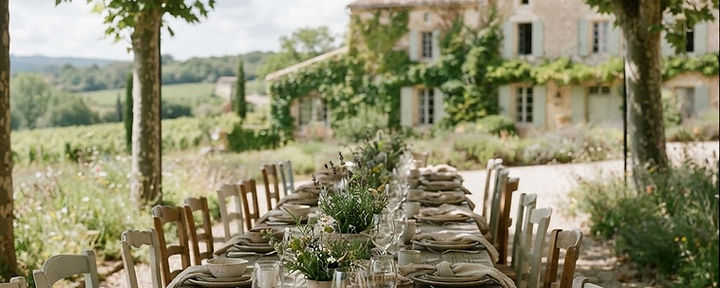
There is a reason retreats happen away from the office, and it is not the catering. Familiar rooms produce familiar behaviour: the same seating, the same reflexes, the same people speaking in the same order. Changing the conditions is the cheapest intervention available to you. On the estate we work with, that means woodland, a stream with waterfalls, old stone, and rooms that have been standing for two hundred years.


Place is not decoration; it is a change of conditions. Horses make the point even more plainly. They respond to what a person actually does rather than to what that person says about themselves, and the gap between the two is where most leadership learning sits. You cannot perform your way through an afternoon in a paddock.
Design in three movements
A retreat that holds together behaves like a piece of music. It arrives, it works, and it resolves. The most common error is to fill the arrival with a workshop and the resolution with a long walk, which leaves the difficult work stranded in the middle with no time to land.
- 01Descent. The first half-day is not for content. It is for arrival, for food, for a walk, and for a first conversation that is allowed to be informal. Teams need to become a group again before they can disagree usefully.
- 02The work. Two or three deep sessions rather than eight shallow ones. Long enough to get past the first answer, which is usually the one people have been giving in meetings for months.
- 03Ascent. The final afternoon belongs to decisions, owners and dates, written down before anyone leaves the site. Not a summary of feelings: a short, concrete record of what changes.
The practicalities that decide whether it lands
- 01Travel time is design. Anything beyond one simple journey costs you a session in the morning and a real conversation in the evening.
- 02Whole-site exclusivity matters more than people expect. Shared corridors with another company will quietly pull your team back into social performance.
- 03Mix the table. Change who sits next to whom, deliberately, at every meal. Most of the informal work of a retreat happens over food.
- 04Leave white space. Two long breaks each day. The insight people remember is usually the one they had while walking, not the one written on the flip chart.
- 05Protect some of the evenings. A retreat with something scheduled every night is a conference with better scenery.
- 06Write the outcome down while you are still there. Commitments made on the estate and typed up a week later rarely survive contact with the inbox.
What to ask before you commit to a venue
- 01Can we have the whole site, and can we see the actual working room rather than a photograph of it?
- 02Who facilitates, and have they sat with a leadership team in the middle of a real disagreement?
- 03What happens if the weather turns, or a session needs to run two hours longer than planned?
- 04How do meals work: one table or several? Fixed or flexible? Food is programme.
- 05What is the honest capacity, not the brochure capacity?
Size and mix
Twelve to twenty people is the range in which a group can still be honest with itself. Beyond twenty-four you are running a conference with a nice location, and the people who most need to speak will not. If the wider organisation must be included, consider a shorter second gathering for them after the core team has done the difficult work, rather than compressing everyone into one room.
When a retreat is the wrong instrument
If the real problem is one person’s behaviour and nobody is willing to name it, three days in the countryside will not fix it. A retreat creates conditions; it does not create courage. When a leadership team is not prepared to be somewhat uncomfortable in front of each other, the more honest advice is to spend the budget elsewhere and say so plainly.
If you are planning something for next year, the useful first step is a conversation about the decision, not the dates. Tell us what your team is navigating and we will tell you honestly whether this is the right instrument.